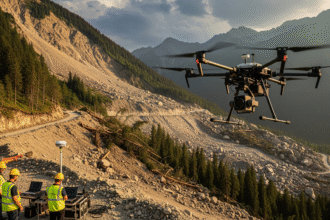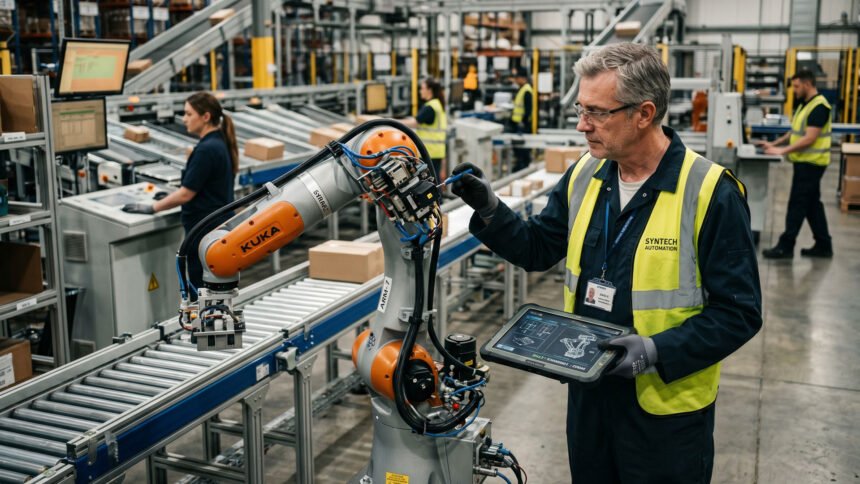
Picture a construction site in NEOM, 170 kilometres of linear city rising from the Saudi desert. Temperatures are hitting 45°C at noon. Deadlines are measured in billions of dollars and national ambition. And a very real problem: not enough skilled workers to build it.
The automation and labor shortage tension in the Gulf isn’t a future scenario. It’s today’s headline, playing out across job sites in Riyadh, warehouses in Dubai, and oil pipelines in Abu Dhabi. The GCC’s workforce challenge is structurally different from the West’s, and the robotic solutions emerging here are just as unique.
How Is Automation Solving the Gulf’s Labor Shortage?
Automation addresses the Gulf’s labor shortage by stepping into roles that go unfilled, not by replacing the workers already doing the job. In a region where expatriates make up nearly 90% of the population in Qatar and the UAE, the dependence on migrant labor has always been the region’s patch for workforce gaps. But that model is under pressure from nationalization targets, kafala reforms, and the sheer scale of Vision 2030-era mega-projects.
Robots don’t need a sponsor visa. They don’t repatriate wages. And crucially, they show up during both harvest heat and Ramadan peak seasons. That’s not a knock on human workers; it’s a structural reality GCC employers are quietly navigating.
Nearly half of employees in the Middle East (49%) expect AI, robotics, and automation to impact their jobs significantly over the next three years, ahead of the global average of 45%, according to PwC’s 2025 Workforce Survey. And 75% of regional workers have already used AI tools in their roles over the past year, outpacing the global figure of 69%. This isn’t a workforce being blindsided by machines. It’s a workforce that’s already working alongside them.
Which GCC Industries Are Deploying Robots Right Now?
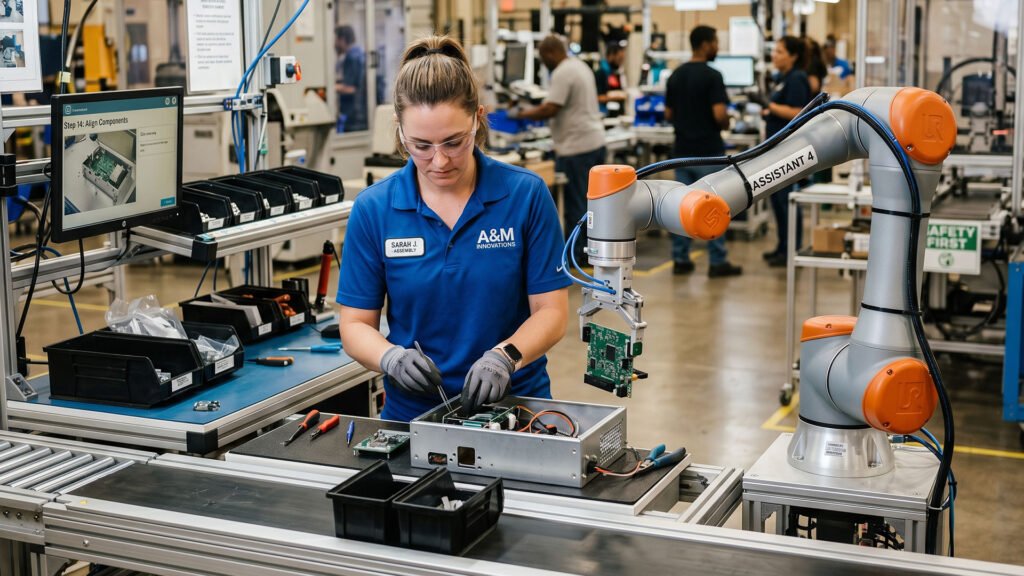
Oil & Gas: Aramco, ADNOC, and the Autonomous Field
The Gulf’s crown jewel sector was always going to lead. Saudi Aramco signed an MoU with Cybernetix, a subsidiary of Technip Energies, to explore integrated robotics solutions for autonomous inspection and maintenance operations, a move that signals serious intent beyond pilot projects. The collaboration feeds into Aramco’s own SAAR (Saudi Aramco Autonomous Robotics) initiative, which is targeting the dirtiest, most dangerous, and most labor-intensive corners of field operations.
In Abu Dhabi, ADNOC has been deploying digital oilfield technologies across its upstream operations, with Abu Dhabi leading in exploration, production, and the deployment of digital oilfield technologies, given the concentration of major reserves and infrastructure in the emirate. The pattern is consistent: automate inspection, free up engineers for higher-order analysis.
Construction: NEOM, Dubai, and the Labour Crunch
Construction is where the Gulf’s labor shortage bites hardest, and where robots are making the boldest entry. NEOM announced plans to invest in Danish startup GMT Robotics, whose systems can reduce the on-site workforce by up to 90%. The goal isn’t mass layoffs; NEOM has framed this as a strategy to localize technology, promote sustainable development, and create high-skilled jobs in a market starved of qualified tradespeople.
In the UAE, Buildroid AI raised $2 million to launch AI-powered block-laying robots and digital twin simulations aimed at the UAE’s $42.75 billion construction market. Its CEO put it plainly: deployment of robots will enable the creation of more professional and highly paid positions, such as robotic operators, and design-to-build time will be optimised by 15 to 20 per cent . UAE construction was projected to grow 5.2% in 2025 and reach $130 billion by 2029, a scale that simply cannot be met with manual recruitment alone.
Logistics & Warehousing: Last-Mile Goes Autonomous
Dubai aims to have 70% of the city covered by drone delivery by 2030, with the autonomous last-mile delivery market in the UAE alone valued at $1.1 billion in 2024 and expected to reach $1.85 billion by 2030. That’s not a moonshot, it’s a procurement timeline.
Logistics and warehouse automation in the UAE is expected to hit $1.6 billion by 2025, driven by the surge in e-commerce and demand for faster, more efficient order fulfillment through AI-powered robotics. Companies like IQ Robotics are already running large-scale warehouse deployments, and Dubai’s Crown Prince launched the Dubai Robotics and Automation Program with an ambitious goal of deploying 200,000 robots over the next decade and increasing the robotics sector’s contribution to Dubai’s GDP to 9%.
That’s a jobs-creation bet disguised as an automation strategy.
Does Automation Actually Eliminate Jobs in the GCC?
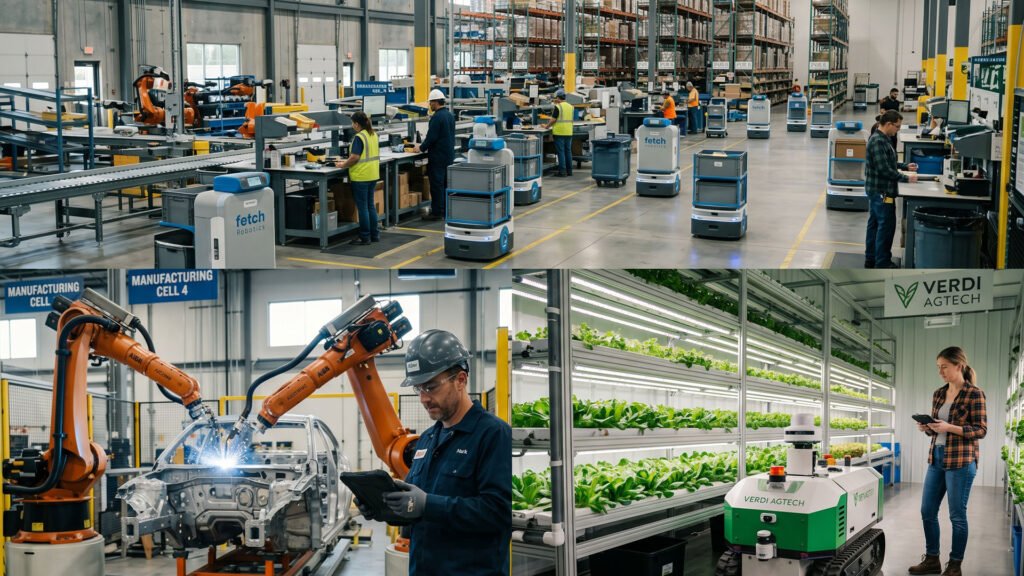
In most documented GCC cases so far, the answer is no, but the transition demands attention.
While some fear AI will lead to mass job losses, regional HR experts say it will instead reshape existing roles, with routine jobs fading and being replaced by positions that demand analytical, digital, and advanced interpersonal skills. A 2024 survey found that 56% of companies in the Middle East and North Africa are using AI, compared to 85% in the EU and the US, meaning the Gulf is still in the acceleration phase, with time to build skills ahead of the curve rather than scramble behind it.
Saudi Arabia’s robotics market reached $554.9 million in 2025 and is forecast to hit $2.1 billion by 2034, a trajectory that has already created an industry of integrators, fleet operators, and maintenance engineers where none existed a decade ago.
The real risk isn’t robots taking jobs. It’s a skills gap opening between the workers who learn to run these systems and those who don’t. Industry talent shortages in AI and robotics are already being flagged as critical gaps in Saudi Arabia’s labor market through to 2030, with higher education increasingly pressured to close them. The window is open, but it won’t stay open indefinitely.
What Gulf Workers and Businesses Should Do Right Now
If you’re a business operating in the GCC, the playbook is becoming clearer. Saudi Arabia’s National Industrial Development and Logistics Program offers substantial funding and support for businesses adopting automation, accelerating cobot deployment across manufacturing and logistics. PROVEN Robotics in Saudi Arabia has pioneered a Robots-as-a-Service (RaaS) model, making automation accessible through a platform that allows non-coders to manage robots, which means the barrier to entry is no longer technical expertise; it’s decisiveness.
For workers, the shift is already happening in plain sight. The “robot technician” and “automation specialist” categories are among the fastest-growing job titles across Gulf job boards. Companies like Aramco, ADNOC, and NEOM are not just deploying robots; they’re building the teams that maintain, calibrate, and evolve them. The Mohamed bin Zayed University of AI in Abu Dhabi and Saudi Arabia’s SDAIA Academy are producing graduates specifically for this ecosystem.
The question for any professional in the region isn’t whether to engage with this transition. It’s how soon?
The Automation and Labor Shortage Story in the Gulf Is Just Beginning
The automation and labor shortage dynamic in the Gulf is unlike anywhere else on Earth. The region isn’t dealing with a retiring boomer generation or rural recruitment crises; it’s managing the tension between nationalization mandates, mega-project ambition, and a migrant labor model that can’t indefinitely absorb the load.
The companies moving fastest, Aramco, ADNOC, NEOM, and the Dubai logistics ecosystem, aren’t replacing their people. They’re doing something more strategically interesting: they’re building workforces that know how to run machines, in a region that has the capital to make it happen at scale.
The robots aren’t coming for the Gulf’s jobs. In most cases, they’re arriving because the jobs were already going unbuilt, undelivered, and uninspected.
That changes the question entirely. It’s not whether automation is reshaping work in the GCC; it already is. The question is whether your next role in this economy will be defined by that shift, or disrupted by it.